
ChipBiz is a game I have been building, and I wanted to share it. You run a CPU company: you start in a garage in January 1971 with a little money, and try to grow it into a chip giant.
In November 1971 Intel ships the 4004, and the race begins. The calendar runs to 2026 with the real chips of each era, then on into an openly fictional future up to 2036. It is free and runs in the browser at chipbiz.smgame.net.
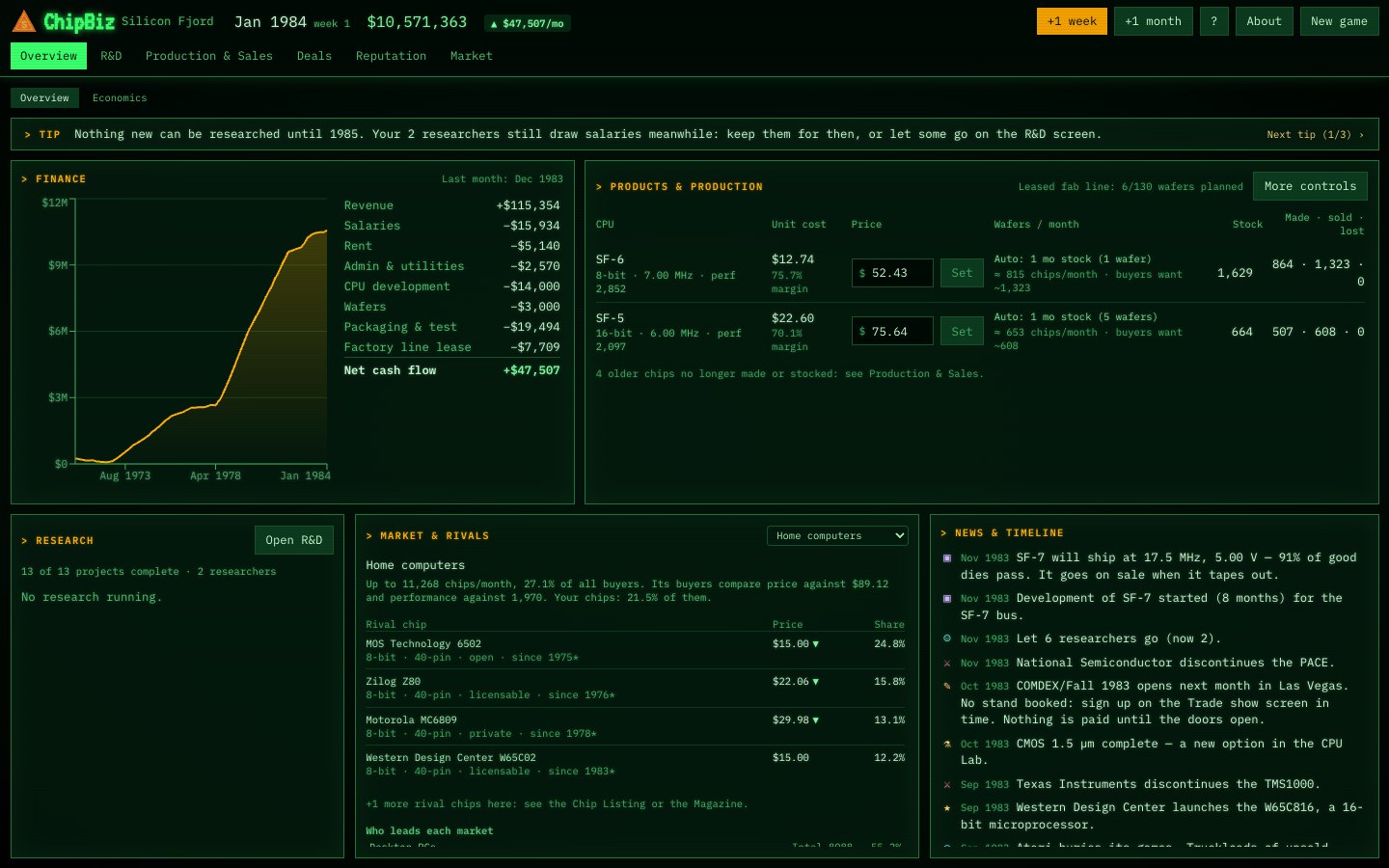
The question behind it is simple: could you have done better than the companies that actually built the industry?
What it does
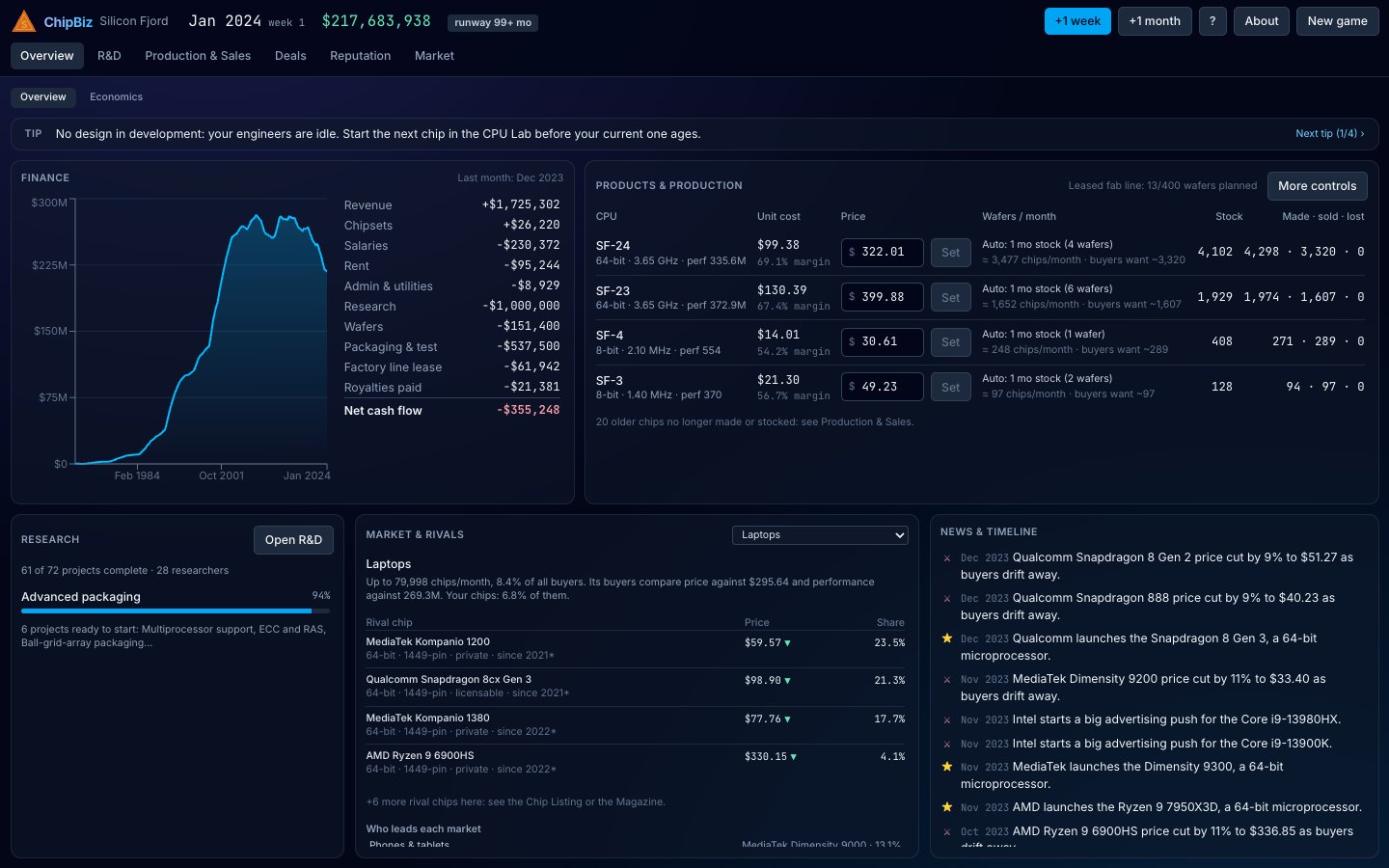
Each turn is one month. You research, design, test, make and sell chips, then put the money back in and try to survive the next change in technology.
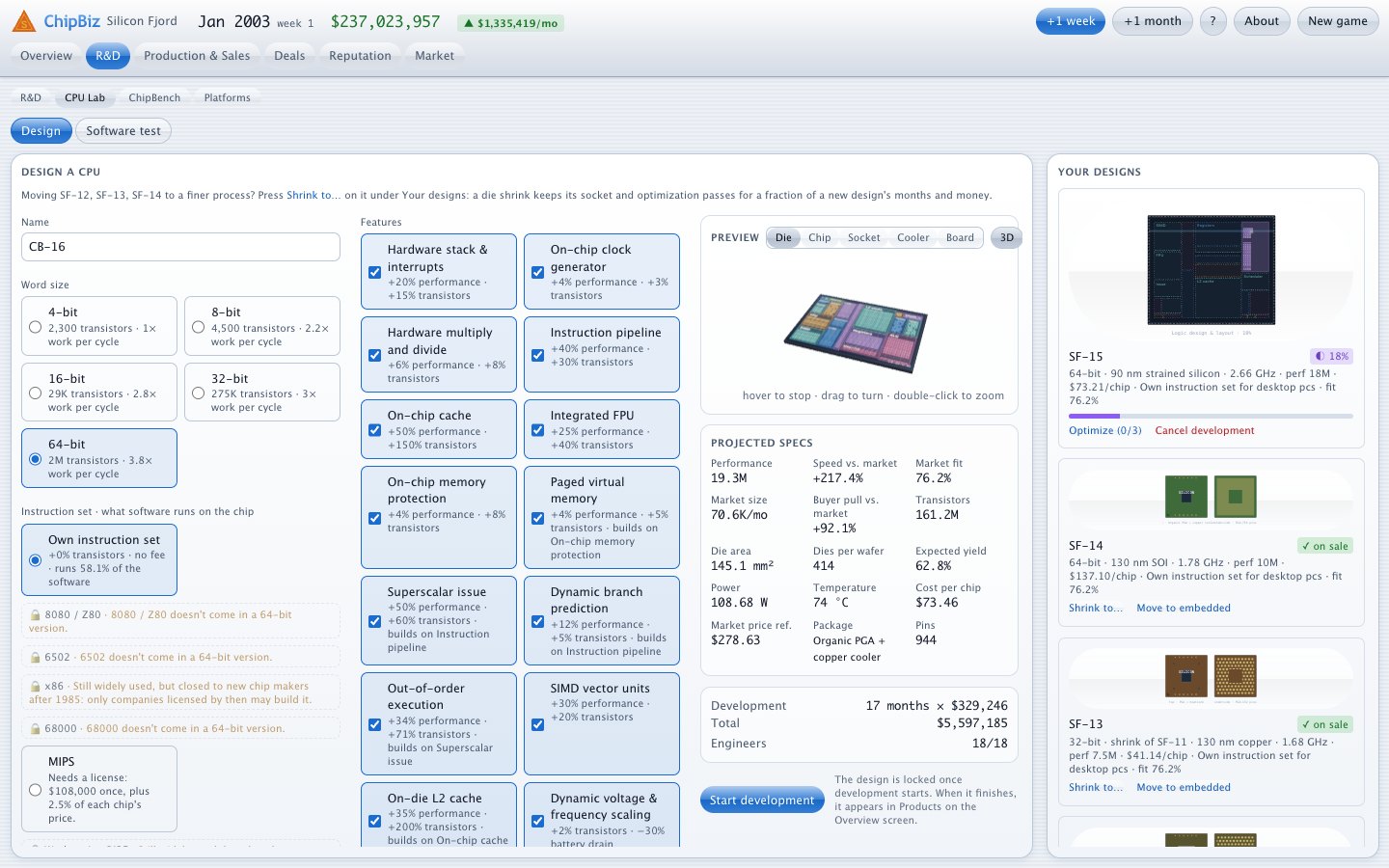
- Research. 4-bit and 8-bit, PMOS and NMOS, later CMOS, pipelines, caches and multicore. New technology needs research and prerequisites, not just the right year, so you can get there before history did.
- CPU Lab. Design your own chips and trade clock speed against yield, die area and cost. Every design gets its own die, package and reference motherboard with a socket.
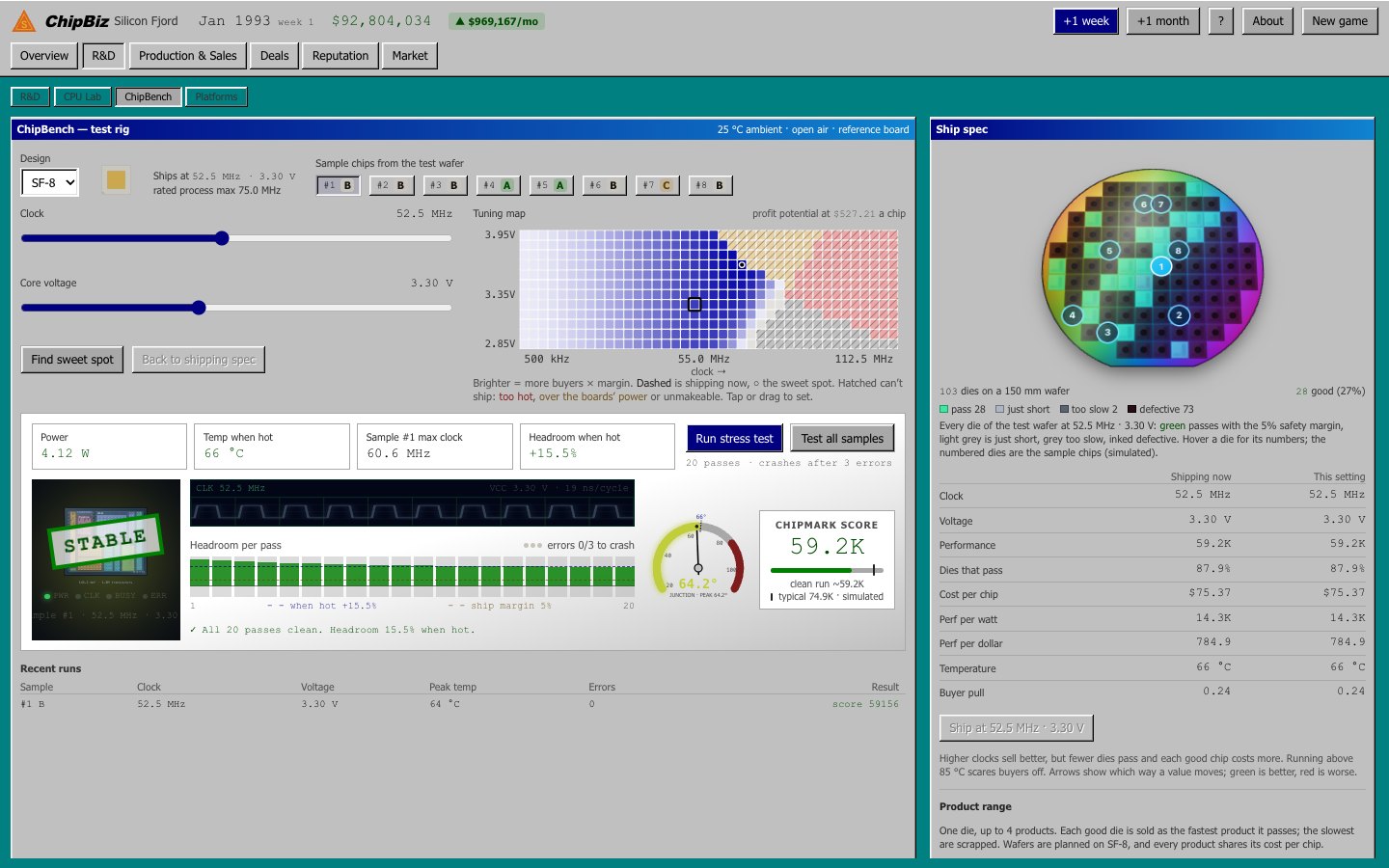
- ChipBench. Sample chips come out of the fab at different quality. Push them at the clock and voltage you choose, watch the temperature and stability live, and decide what spec to sell them at.
- Selling. Set prices, pick your markets, bid for console and OEM contracts, and build a reputation.
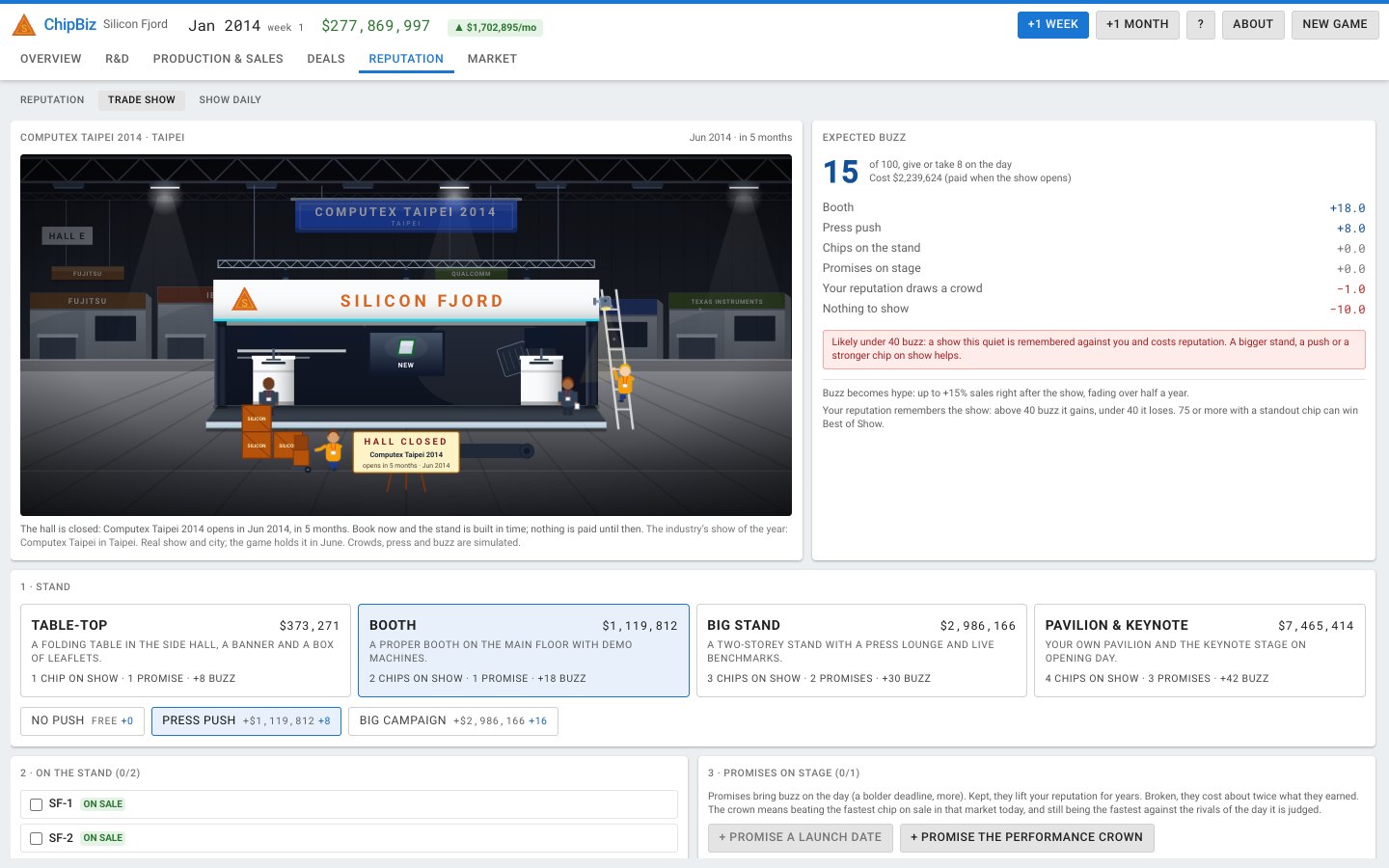
- The trade show. Once a year you can book a stand, show your chips or a sneak peek, and make promises on stage. The press remembers whether you kept them.
The office grows with you, from the garage to bigger buildings, with your staff at work at their desks.
One rule runs through all of it: there is no free performance. A faster chip runs hotter, costs more, yields worse or takes longer to research. And the fastest chip doesn’t always win. Price, availability, compatibility and contracts matter too, and you can do very well by owning one niche.
Real chips, real history
The rivals in ChipBiz are the real ones. The 4004 arrives in 1971, the MOS 6502 in 1975, the AMD Athlon in 1999 and Ryzen in 2017. Behind them is a catalogue of more than 5,000 historical CPUs and SoCs, about 470 industry events from 1970 to 2026, and the sockets, consoles and platforms of each era. The instruction sets are there too: 8080 and Z80, 6502, 68000, x86, MIPS, PowerPC, SPARC, SuperH, ARM and more.
The history is a starting point, not a script. The real dates and chips are facts, but sales, market shares, prices and how the rivals respond are simulated, and the game labels them that way. Your choices can change what happens next.
After 2026 the game goes on into a made-up future, with more than 1,000 fictional chips up to 2036. None of them are real announcements; it’s a sandbox for seeing where your company ends up.
Play together
Up to eight companies can share one market. Pick Multiplayer on the start screen, create a room, and send the code or the invite link to your friends.
Everyone plays the weeks of a month at their own pace. The month only ends when all players have pressed Ready for next month, so everyone moves on together. After each month your company’s public numbers go out to the others, and your chips compete with theirs for the same buyers.
If you would rather play alone, there are Easy, Normal and Hard, and a Custom mode where you set the starting money, how strong the rivals are and the year you start in.
A few things added in the last week:
- Market experience. Selling to a market builds experience there. Pick up to two focus markets to master them.
- Go back after a bankruptcy. The game keeps a copy of your company every January and July, so you can play on from one of the last three.
- 713 more real chips. Missing chips across every instruction set, each with its own art, and the rivals sell them too.
- A trade show you can watch. The show plays out on a hall floor in the style of its decade, with your stand in your company colours.
How it is made
I made it with AI coding agents, mostly Claude Code, starting on 18 October 2026. Ten days and almost 500 commits later, this is where it stands.
It is a web app in React and TypeScript, built with Vite. The simulation runs on its own in a Web Worker, one month at a time, and it is deterministic: the same choices always give the same result, and the code doesn’t allow random numbers that can’t be repeated. The dies, packages and offices are generated in code, not drawn by hand.
The game and the multiplayer rooms run on Cloudflare. Each room is a Durable Object that sleeps when nobody is playing, so at hobby-game traffic it all fits in the free plan. Your game is saved in your own browser, and a reload takes you straight back into your room.
Try it
ChipBiz is free to play at chipbiz.smgame.net. There is nothing to install and no account to make. New to it? The illustrated player guide, styled as an old computer magazine, is linked from the start screen.
It is a hobby project and a work in progress, and the balance numbers are still being tuned. I add things almost every day, and the latest changes show under What’s new on the start screen.
If you ever wanted to run Intel or AMD, or just beat them, I would love to hear how far your company gets. And if you enjoy it, you can buy me a coffee.