 Wattbar
See how many watts your Mac uses, right in the menu bar.
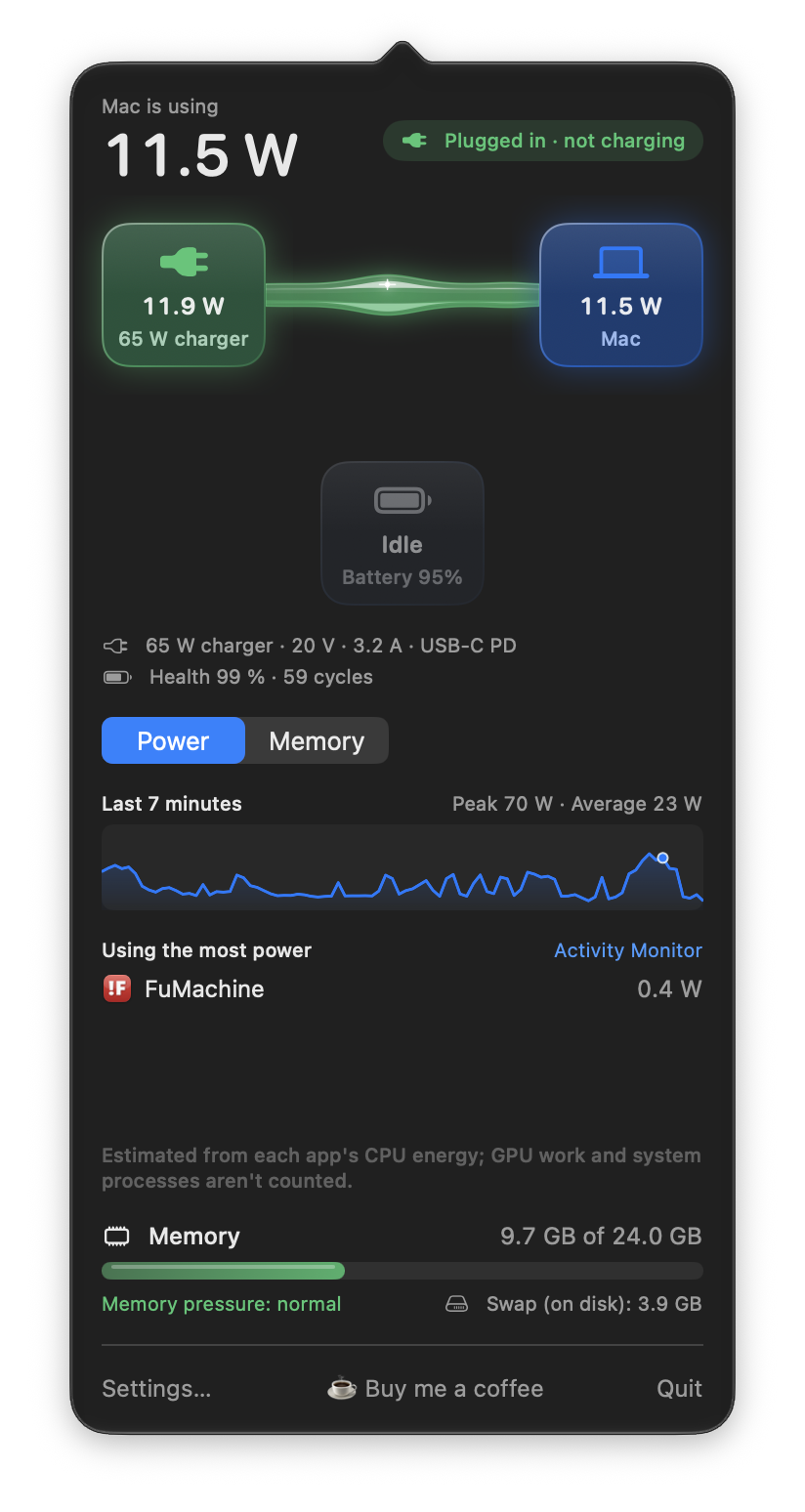
Wattbar shows what the Mac draws, what the charger delivers and what goes in or out of the battery, updated every second. Click it to see where the power goes, what has used it the last half hour, and which apps use the most.

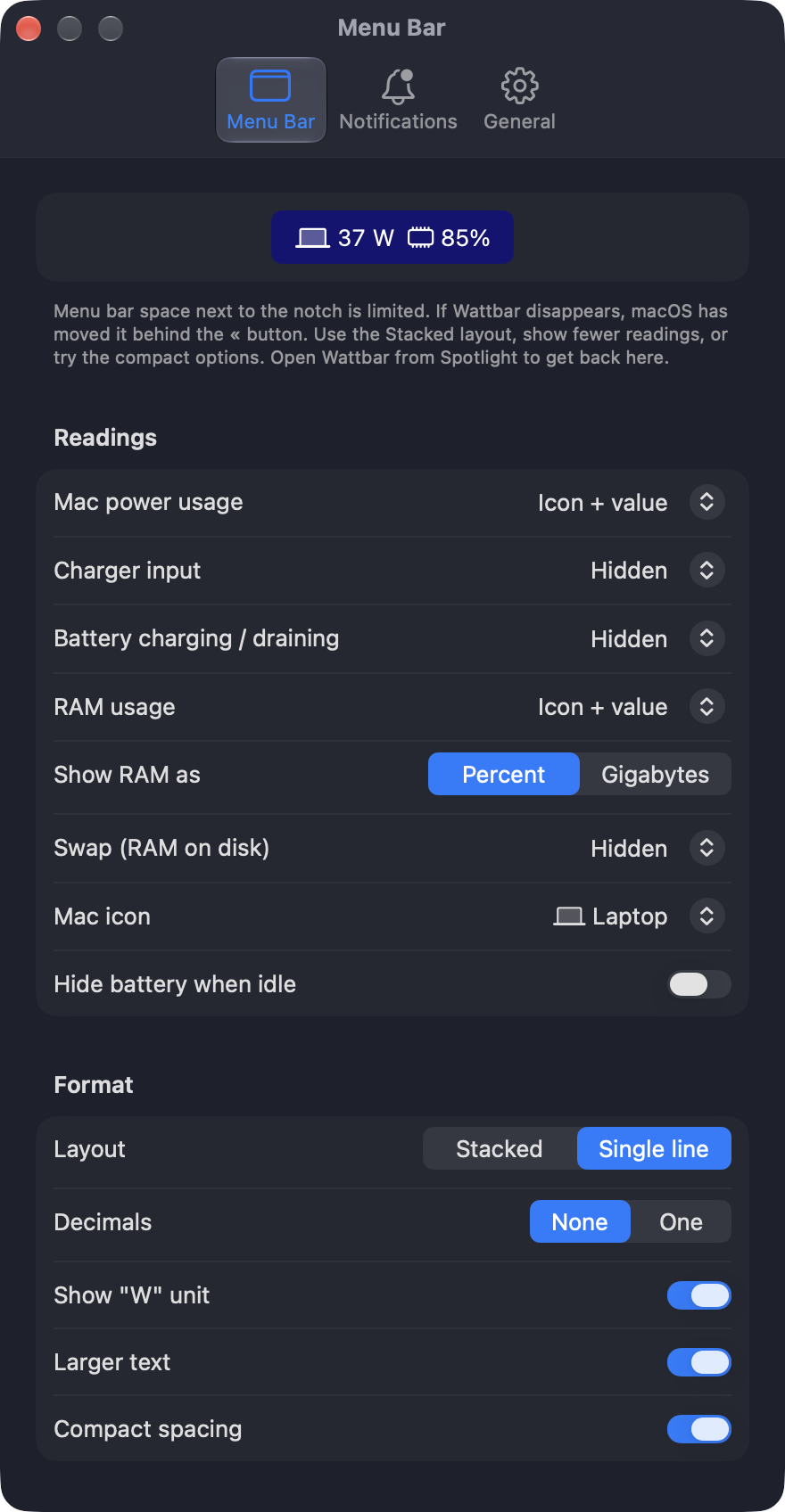
In the menu bar it is just a number or two, small enough to sit next to the notch. Show the Mac, the charger, the battery, memory and swap, as icons with values, values only, or not at all.
Where the power goes, as it happens.
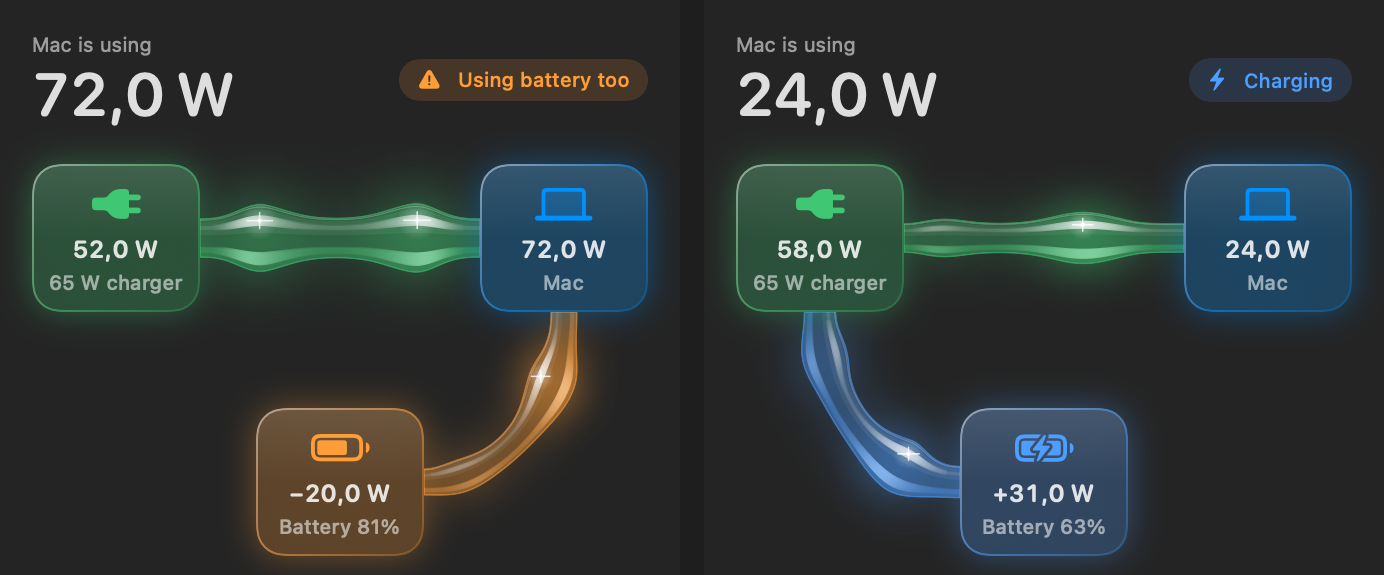
Click Wattbar and the panel shows the charger, the battery and the Mac, with glass tubes between them. The tubes glow and swell with the watts that run through them, so you can see at a glance whether the battery is charging, helping out, or resting.
What the Mac uses
The whole computer: processor, graphics, screen, everything plugged in. Read from the Mac's own power sensors, the same numbers macOS uses itself.
What the charger delivers
With the charger's rating, voltage and current, for example 96 W charger · 20 V · 4.7 A. Handy when one charger seems slower than another.
What goes in or out
Plus for charging, minus for draining. With time left or time to full, the battery's health and how many cycles it has been through.
What happened the last half hour, and who did it.
Under the flow is a small graph of the last 30 minutes, with the peak and the average. Hold the pointer over it to read the value at that moment, to find out what the peak actually was and when.
Below that are the apps using the most power right now, from the energy macOS counts for each app. When the number is high, that is the answer to why. One click opens Activity Monitor for the rest.
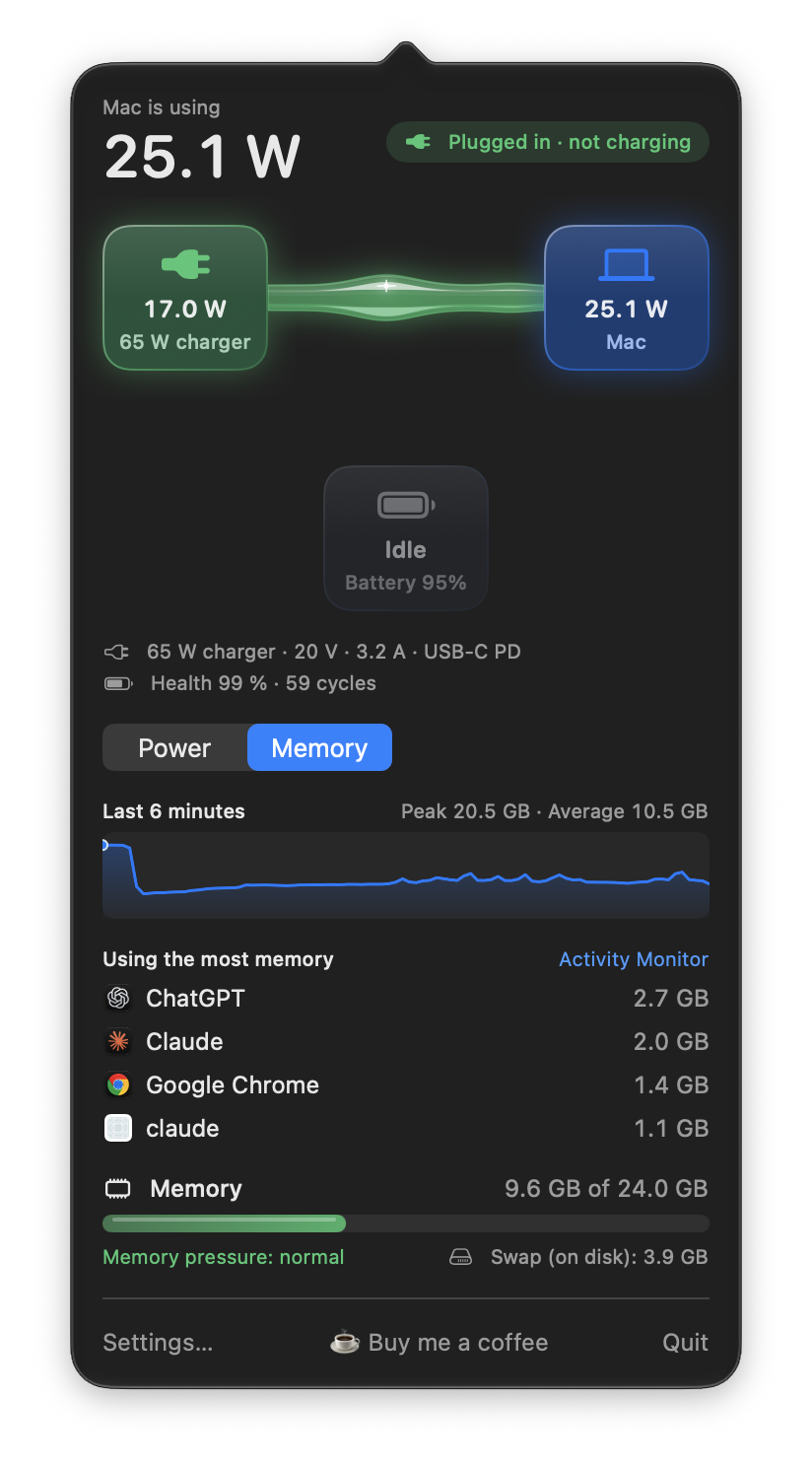
Switch the panel from Power to Memory and the same graph and list show memory instead: how much is in use, memory pressure, how much has been moved to disk (swap), and the apps holding the most.
As much or as little as you want up there.
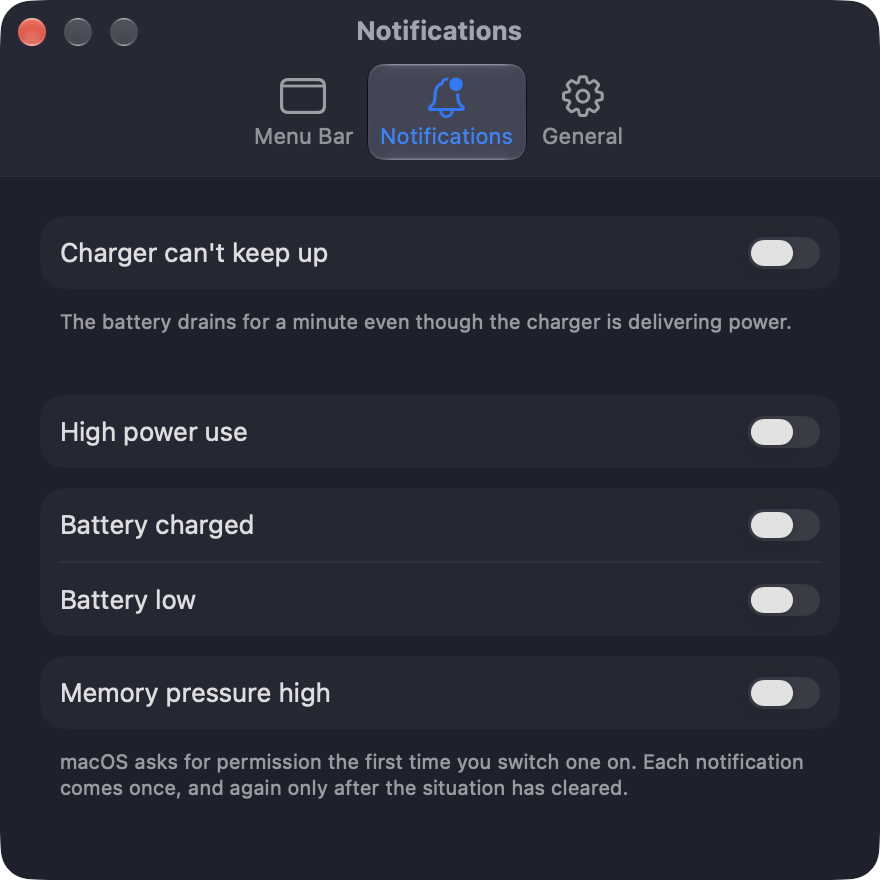
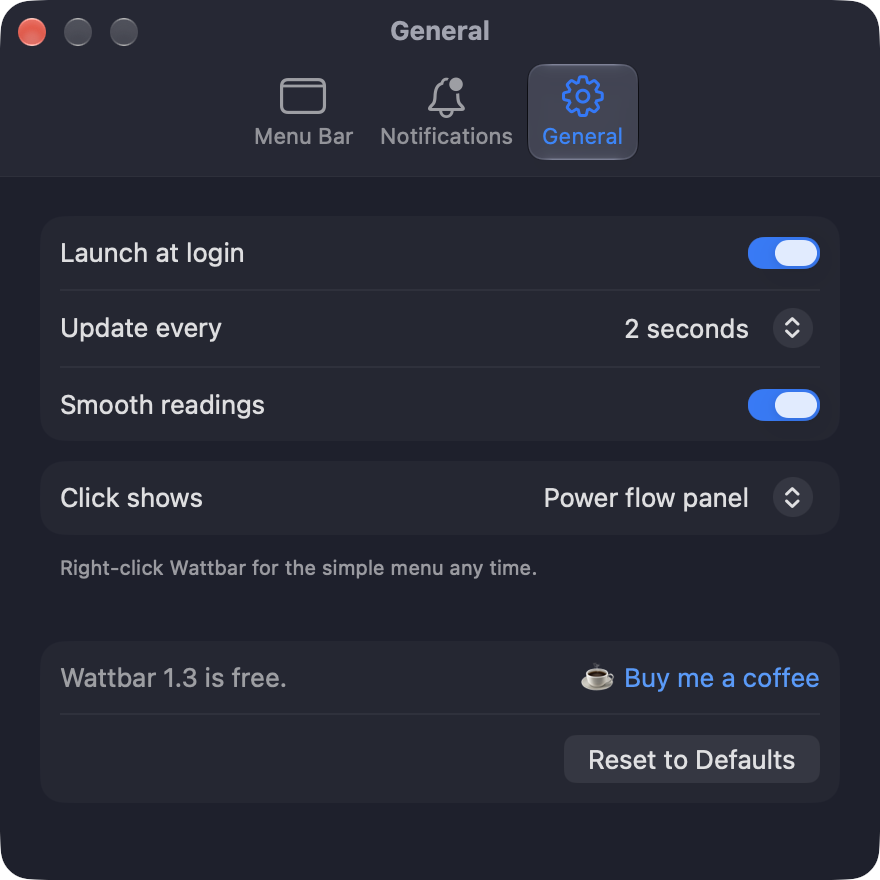
Everything is set in Settings, in three tabs: Menu bar, Notifications and General.
A heads-up when something is off.
All off by default. Switch on the ones you want and set your own limits. Each one comes once, and only again after the situation has cleared, so they don't nag.
- Charger can't keep up. The battery drains for a minute even though the charger is delivering power. Usually a weak charger or cable.
- High power use. The Mac has used more than a number of watts you choose, for as many minutes as you choose.
- Battery charged. The battery has reached your percentage, so you can unplug.
- Battery low. The battery is down to your percentage on battery power.
- Memory pressure high. macOS says memory is running short, before things slow down.
A power meter shouldn't use power.
Measured on a MacBook Pro with M5 Pro, updating every 2 seconds: the processor use is the average over a minute, from the CPU time macOS counts for Wattbar. The animation stops as soon as the panel closes or is covered, and with Reduce motion on.
Apple silicon only. Wattbar reads the power sensors of M1 and later Macs. Intel Macs aren't supported.
A desktop Mac has no battery or charger readings. On a Mac mini, iMac, Mac Studio or Mac Pro, Wattbar shows what the Mac uses, and memory.
The app list is an estimate. It comes from the energy macOS counts for each app, which leaves out things like the screen. It tells you who uses the most, not exactly how many watts each one uses.
Nothing leaves your Mac. No account, no analytics, no update checks. Wattbar doesn't connect to the internet at all.
Made with Claude. Wattbar was written together with Anthropic's Claude, and tested on my own Mac.
Version 1.3
— downloads— visitorscounted once the page is on stigern.net
macOS
macOS 13 Ventura or later, Apple silicon. Signed and notarized by Apple.Wattbar-1.3.zip1.8 MBSHA-256 ca3e2c6f90f5471822d5b5b410938cab8e36343b80ca43086b715db0b76580afUnzip, drag Wattbar to Applications and open it. It shows up in the menu bar, not in the Dock. To get to Settings, click Wattbar and choose Settings…, or open Wattbar again from Spotlight. If Wattbar doesn't appear next to the notch, macOS has hidden it for lack of room: choose the stacked layout or fewer readings in Settings.
Free. What changed is in the changelog below. If you like it, you can buy me a coffee.
☕ Buy me a coffeeWhat changed in each version.
Version 1.3
2026-10-13
New
- A graph of the last 30 minutes in the panel, with peak and average. Hold the pointer over it to read the value at that moment.
- The apps using the most power right now, with a button for Activity Monitor.
- A Power / Memory switch in the panel: the graph and the app list show memory use, and the apps holding the most memory, instead.
- Battery details: time left or time to full, battery health and cycle count.
- Charger details: rating, voltage and current.
- Notifications, all off by default and with your own limits: charger can't keep up, high power use, battery charged, battery low, memory pressure high.
- Settings in three tabs: Menu bar, Notifications and General.
- A new app icon.
Fixed
- On a Mac without a battery, Wattbar no longer says it runs on battery, and a reading that is missing shows as missing instead of 0 W.
- One failed reading at start no longer leaves Wattbar on its slower backup source for good.
- Smoothing no longer mixes the numbers from before and after the charger is plugged in or out. Peaks, averages and notifications use the real readings, not the smoothed ones, and averages count time, not samples.
- The memory percentage no longer gets stuck, and memory keeps working when the power readings don't.
- A notification that couldn't be shown (notifications not allowed yet) comes once they are, instead of being lost. The "for N minutes" timers start over after a gap in the readings or a changed limit.
- The app list no longer gives one app's numbers to another that got the same process number.
- Reset to Defaults also resets the Power / Memory choice.
Improved
- Less processor use while the panel is closed. The Settings window no longer keeps running after it is closed.
- The animation stops when the panel is covered, and with Reduce motion on.
Version 1.2
2026-10-13
New
- Memory in the menu bar, in percent or gigabytes, and in the panel with memory pressure.
- Swap (memory moved to disk) as a reading of its own.
Fixed
- The panel no longer jumps around when it opens.
- Several smaller fixes, and less processor use.
Version 1.1
2026-10-10
New
- The power flow panel: the charger, the battery and the Mac, with animated glass tubes showing where the power goes.
- A setting to keep the simple text menu instead of the panel, and the simple menu on right-click.
Version 1.0
2026-10-10
First version
- What the Mac uses, what the charger delivers and what goes in or out of the battery, in watts in the menu bar.
- Each reading as icon and value, value only, or hidden; a stacked layout that fits next to the notch.
- Launch at login, update interval and smoothing.